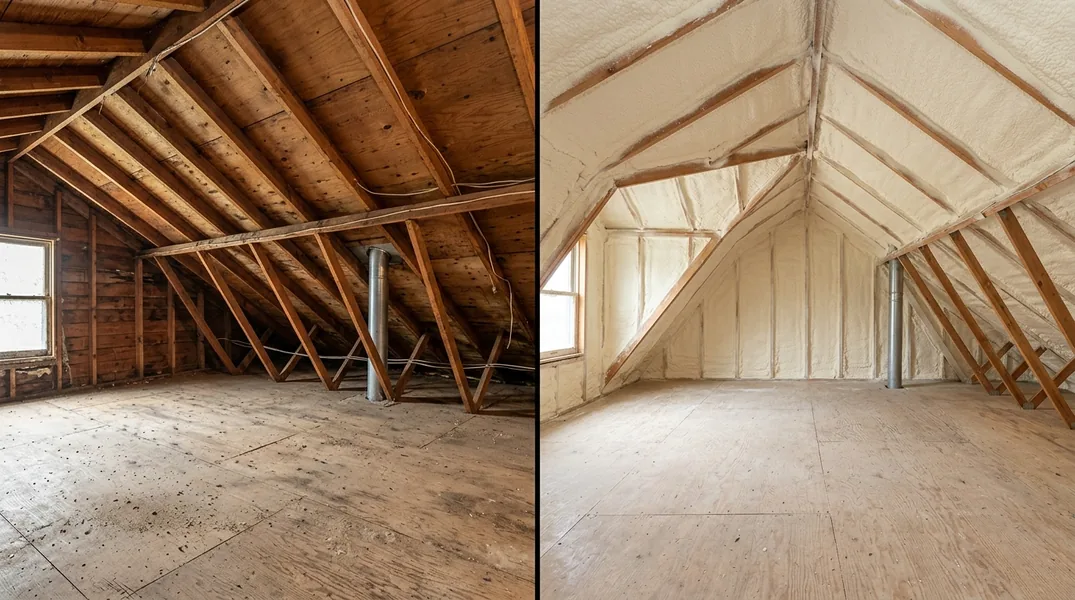
Understanding Open Cell vs Closed Cell Spray Foam
When you're preparing for an Attic Spray Foam Insulation project in Champaign, one of the first decisions you'll face is choosing between open cell and closed cell spray foam. These two types look similar when applied, but they have fundamentally different structures and performance characteristics that will affect your home's comfort, energy efficiency, and long-term costs.
Open Cell Spray Foam has a structure where the bubbles are not completely enclosed. This makes the material softer, more flexible, and more breathable. Think of it like a sponge where the air pockets are connected to one another. Closed Cell Spray Foam Insulation, on the other hand, has completely sealed bubbles that trap air and moisture inside. This creates a denser, more rigid material that offers superior moisture resistance and structural support. Understanding these differences is crucial before you commit to a spray foam job, as each type serves different purposes and performs differently depending on your home's needs.
Spray Foam R Value: What You Need to Know
R-value measures how well insulation resists heat transfer. The higher the R-value, the better the insulation performs at keeping your home warm in winter and cool in summer. This is one of the most important metrics homeowners should understand before scheduling any insulation work. Closed Cell Spray Foam Insulation typically achieves an R-value of 6 to 7 per inch of thickness, making it one of the most efficient insulation materials available. Open cell spray foam, by comparison, delivers an R-value of around 3.5 to 4 per inch, which is still respectable but requires greater thickness to achieve the same insulation performance.
For attic insulation in Champaign, the Department of Energy recommends R-values between R-38 and R-60, depending on your climate zone and heating/cooling system. With closed cell foam, you might need only 6 to 8 inches to meet these standards, while open cell would require 10 to 15 inches. This thickness difference has real implications for your attic space, cost, and installation complexity. Before scheduling your spray foam job, ask your contractor to calculate the exact R-value needed for your home and show you how many inches of each foam type would be required to achieve that target.
Open Cell Spray Foam: Benefits and Limitations
Open Cell Spray Foam is an excellent choice for homeowners who prioritize sound dampening and flexibility. Because the cell structure is open, the material absorbs sound waves effectively, making it ideal if you're concerned about noise from outside or between rooms. The softer, more flexible nature of open cell foam also means it can conform to irregular spaces and won't create stress on framing members as it cures. Many homeowners appreciate this characteristic because it reduces the risk of structural issues over time.
However, open cell spray foam has important limitations you should understand. It's not moisture resistant, which means it can absorb water if exposed to leaks or high humidity. In attics or crawl spaces where moisture control is critical, this can be a significant drawback. Additionally, because it requires more thickness to achieve the same R-value as closed cell, it takes up more space in your attic, potentially reducing usable storage area. Open cell is also more permeable, meaning air and moisture can pass through it more easily. If your primary goal is maximum insulation performance and moisture protection, closed cell may be the better investment despite its higher upfront cost.
Closed Cell Spray Foam: Superior Performance and Durability
Closed Cell Spray Foam Insulation is the premium choice for homeowners seeking maximum insulation efficiency and long-term durability. The closed cell spray foam r value of 6 to 7 per inch makes it the most efficient foam insulation available, meaning you need less material to achieve excellent thermal performance. Beyond R-value, closed cell foam provides exceptional moisture barriers, air sealing, and structural reinforcement. The rigid, dense nature of closed cell foam actually adds strength to your attic or wall framing, which can be valuable in homes experiencing settling or structural stress.
The moisture resistance of closed cell foam is particularly important for Champaign homeowners. Our region experiences seasonal humidity variations and occasional heavy rains, and closed cell foam's impermeable structure protects your attic from moisture infiltration and mold growth. This also means the foam won't degrade over time due to moisture exposure, giving you longer-lasting insulation performance. The trade-off is cost: closed cell foam typically runs 40 to 60 percent higher than open cell, and installation may require additional structural preparation. However, many homeowners view this as an investment in long-term energy savings and home protection. If you're planning to stay in your home for many years, closed cell often delivers better return on investment through reduced heating and cooling costs.
Attic Spray Foam Insulation Cost in Champaign: What to Budget
Before you schedule your spray foam project, you need to understand what you'll actually spend. The cost of Attic Spray Foam Insulation varies significantly based on several factors, including foam type, attic size, existing insulation, and accessibility. Open cell spray foam typically costs between $0.50 and $1.00 per board foot, while closed cell spray foam ranges from $1.00 to $2.00 per board foot. For a typical 1,500-square-foot attic, you might expect to spend between $2,500 and $7,000, depending on the foam type and R-value target you choose.
Beyond material costs, you should factor in labor, equipment, and site preparation. Professional installation requires specialized equipment and trained technicians, which adds to your total project cost. Some homes may need air sealing work before foam application, or removal of old insulation, which increases expenses. Rather than guessing about pricing, the best approach is to contact Champaign Spray Foam Insulation at (447) 895-0419 or request a free estimate for your specific project. A professional assessment of your attic will give you an accurate quote and help you understand whether closed cell's higher upfront cost justifies the long-term energy savings for your situation.
Key Questions to Ask Before Your Spray Foam Installation
Before you commit to a spray foam insulation project, prepare a list of questions for your contractor. Ask which foam type they recommend for your specific application and why. Request a detailed explanation of how they calculated the R-value needed for your home. Ask about moisture management, air sealing procedures, and any structural preparation required. Find out what warranty they offer and what it covers. Understanding these details will help you make an informed decision that aligns with your home's needs and your budget.
You should also ask about the installation timeline and any disruptions to your home during the project. Some spray foam installations require you to vacate your home temporarily due to fumes, while others are less disruptive. Ask about ventilation requirements and any post-installation care. Finally, discuss energy efficiency expectations and ask for an estimate of how much you might save on heating and cooling costs annually. These conversations will ensure you're fully prepared and confident in your spray foam investment. When you're ready to move forward, reach out to Champaign Spray Foam Insulation for a professional consultation and free estimate tailored to your home.
Looking for a professional spray foam insulation contractor in Champaign? Champaign Spray Foam Insulation responds fast for all your spray foam insulation needs.
Get a Free Quote