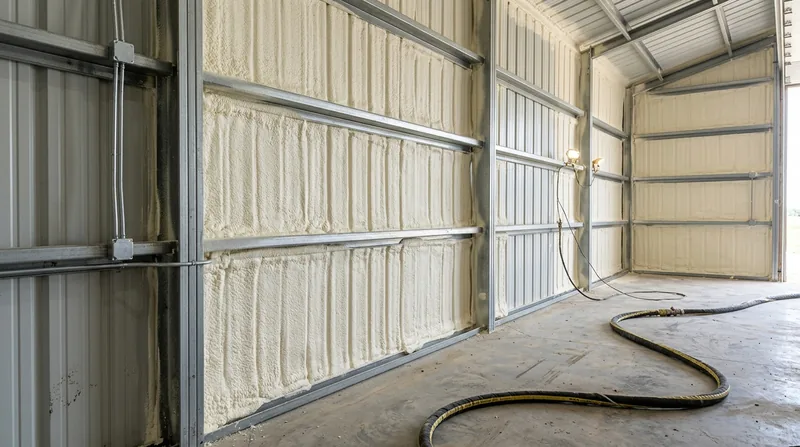




Metal Building & Barndominium Spray Foam in Champaign solves the core problem of temperature swings and condensation in metal-skinned structures across Central Illinois farmland. Machine sheds, shops, and converted barndominiums in Champaign County face brutal winters with wind-driven cold and summers where heat radiates through bare metal, creating interior temperature swings of 40 degrees or more. Spray foam insulation adheres directly to the metal skin, eliminating the air gap where condensation forms and drips onto equipment and stored goods. Unlike fiberglass batts or blown cellulose, foam creates an unbroken thermal and moisture barrier, cutting energy loss and protecting your building envelope from the long cold winters of this region. We have been installing spray foam insulation since 2012, and metal buildings remain one of the highest-value applications for the product because the problem it solves is both immediate and expensive to ignore.
Why Metal Building & Barndominium Spray Foam Matters in Champaign County
Metal structures in Champaign, Urbana, Savoy, Mahomet, and Rantoul sit exposed to the open prairie wind and the temperature extremes of Central Illinois. A machine shed or shop with uninsulated metal walls loses heat in winter at a rate that makes the space unusable without running a heater constantly, and in summer, the metal acts as a radiator, pushing interior temperatures 15 to 25 degrees above ambient. More damaging still is condensation: when warm, moist air inside contacts cold metal in winter or during temperature swings, water condenses and drips continuously, rusting equipment, rotting wooden beams, and creating an environment where tools and stored materials deteriorate. Spray foam eliminates that air gap and bonds directly to the metal, keeping the surface temperature closer to the interior air and stopping condensation at the source.
- Spray foam adheres to metal skin, eliminating the air gap where condensation forms and drips.
- Closed cell foam creates a vapor barrier, blocking moisture from passing through the wall assembly.
- Insulation stabilizes interior temperature, reducing heating and cooling runtime and lowering utility bills.
- The foam also acts as a secondary air barrier, improving structural rigidity on larger spans and reducing wind-driven infiltration.
These benefits compound over time, especially in farm buildings where the cost of replacing rusted equipment or repairing structural damage from moisture far exceeds the cost of insulation.
Key info: A 40-by-60-foot machine shed in Champaign with uninsulated metal walls loses heat equivalent to leaving a 4-foot window open all winter. Spray foam insulation reduces that loss by 70 to 85 percent, and condensation stops within days of installation. Illinois building code requires attic ventilation in most cases, but metal building insulation is governed by your building official and the energy code for your address; we help you understand what applies.
For detailed guidance on how to verify any spray foam contractor, including ours, visit the Illinois Emergency Management Agency, which maintains state building code resources and can direct you to your local building department.
How We Install Spray Foam on Metal Buildings and Barndominiums in Champaign
Metal building insulation requires careful preparation and technique because the foam must bond cleanly to a smooth, often dusty metal surface, and the installation must control thickness and density to meet code and perform as designed. We start by inspecting the structure for any roof leaks, open seams, or standing water. If we find moisture or active leakage, the leak has to be fixed by a roofer first; we do not spray over wet substrates. Once the structure is dry, we mask off any areas that should not receive foam, set up mechanical ventilation to manage cure fumes, and spray the foam in controlled passes, building thickness according to your target R-value and the manufacturer's specifications for closed or open cell.
- We inspect the metal building interior and roof for leaks, rust, or moisture before starting any work.
- We clean and prep the metal surface to ensure the foam bonds fully and creates an unbroken seal.
- We spray foam in multiple passes, controlling thickness per pass to achieve uniform density and R-value.
- We maintain mechanical ventilation during application and cure, and we enforce a 24- to 48-hour re-entry window before the space is occupied.
- We provide a written estimate that specifies R-value, foam thickness, square footage, and the foam type (closed cell or open cell) we recommend for your building.
The entire process, from prep to final cure, typically takes 2 to 5 days depending on building size and complexity.
Example: A 50-by-80-foot barn being converted to a barndominium near Mahomet required 3.5 inches of closed cell spray foam on the roof deck and 2 inches on the metal walls to reach R-20 and R-13 respectively. We inspected the roof, found and sealed a small leak in the ridge vent, prepped the metal, and completed the spray in three days. The owner reported that interior temperature stabilized within the first week, and condensation on the metal frame stopped completely.
For more on how closed cell foam delivers R-value and vapor control, see our guide to Closed Cell Spray Foam Insulation in Champaign.
| Approach | Description | Best for |
|---|---|---|
| Closed Cell Spray Foam | High-density foam (1.5 to 2.0 lb/cu ft) that creates a rigid, vapor-resistant barrier with R-6 to R-7 per inch. | Metal buildings where condensation control and structural support are priorities; barndominiums requiring vapor blocking. |
| Open Cell Spray Foam | Lower-density foam (0.5 to 0.7 lb/cu ft) that is softer and more flexible, with R-3.5 per inch; allows moisture to pass. | Interior metal buildings where vapor permeability is acceptable and cost is a concern; sound dampening is a bonus. |
| Closed Cell on Roof Deck, Open Cell on Walls | Hybrid approach using closed cell (2 to 3 inches) on the roof to block moisture from above and open cell on walls for cost and flexibility. | Large barndominiums or mixed-use buildings where the roof is the primary moisture risk and wall cost matters. |
| Spray Foam Over Existing Insulation | Adding 1 to 2 inches of closed cell foam over old fiberglass batts or blown-in to boost R-value and air seal. | Retrofit jobs where the existing insulation is intact but undersized; faster and lower cost than full removal and replacement. |
Metal Building & Barndominium Spray Foam Cost in Champaign: What to Expect
Spray foam insulation for metal buildings starts at around $1.75 per square foot for open cell on walls and rises to $2.50 to $3.50 per square foot for closed cell, depending on foam thickness, building size, and access. A 40-by-60-foot machine shed with 2 inches of closed cell on the walls and 3.5 inches on the roof deck typically runs $8,000 to $14,000, while a smaller 30-by-40 shop with open cell might fall in the $3,500 to $6,000 range. The final cost depends on several concrete factors: the total square footage of the building envelope, whether you need vapor blocking (closed cell) or can accept open cell, the complexity of the roof geometry, and access for the spray rig and crew.
Barndominiums under conversion often require higher R-values and closed cell on both roof and walls to meet residential energy code, which increases cost but is necessary for comfort and compliance. If your building has existing insulation that is failed or contaminated, we can remove it first, which adds labor but ensures the new foam bonds cleanly. We always provide a written estimate that breaks down square footage, R-value, foam type, and total cost before we spray anything.
To discuss your specific building and get a no-obligation estimate, call (447) 895-0419 or visit our pricing page for more detail on how we structure bids and what factors move the cost up or down.
Metal Building & Barndominium Spray Foam Near Me: What Champaign Homeowners and Builders Should Know
Hiring the right spray foam contractor is critical because poor installation creates problems that are expensive to fix: inadequate thickness delivers low R-value, uneven spray results in voids and air leaks, and rushing the cure window traps off-gassing fumes in the building. When you are comparing contractors, look for these markers of a professional operation. First, ask for a written estimate that includes R-value, foam thickness in inches, total square footage, and the foam type (closed or open cell). If a contractor gives you a price without those details, walk away. Second, verify that the contractor is fully insured and ask to see a certificate of insurance naming your project; this protects you if something goes wrong. Third, ask how they manage cure fumes and what re-entry window they recommend. Honest contractors enforce a 24- to 48-hour window before the building is occupied; anyone promising immediate re-entry is cutting corners.
- Get written estimates from at least two contractors, and compare the R-value and thickness specs, not just the price.
- Verify insurance by asking for a certificate of insurance; do not accept verbal assurance or a photocopy without a certificate holder listed.
- Ask how the contractor will manage fumes during application and what ventilation they will set up; mechanical exhaust during cure is standard practice.
- Check that the contractor has experience with your building type and can explain why they recommend closed cell or open cell for your situation.
- If your metal building is in an HOA or master-planned community, verify that exterior work (such as vent modifications or sealant work) complies with architectural guidelines before the job starts.
Once you have selected a contractor, confirm the project timeline, the re-entry window, and how they will clean up and dispose of packaging and waste. A professional will answer these questions clearly and in writing.
Ready to get started? Contact us for a free estimate at (447) 895-0419. We serve Champaign, Urbana, Savoy, Mahomet, Rantoul, and the surrounding areas, and we respond within 24 hours.
Metal Building & Barndominium Spray Foam in Champaign: Pricing Guide
| Service | Price | Details |
|---|---|---|
| Open Cell Spray Foam on Walls | Starting at $1.75/sq ft | Includes prep, spray application, and cure management; cost rises with building height, roof complexity, and access difficulty |
| Closed Cell Spray Foam on Roof and Walls | Starting at $2.50/sq ft | Includes vapor barrier, higher R-value, and condensation control; price varies by thickness required and building square footage |
| Hybrid Installation (Closed Cell Roof, Open Cell Walls) | Starting at $2.15/sq ft | Balances moisture control above with cost savings on walls; typical for large barndominiums and mixed-use farm buildings |
| Insulation Removal and Replacement | On estimate | Removal labor and disposal fees depend on existing insulation type, condition, and building size; always quoted separately after inspection |
| Travel and Estimate | Included / Free | No mileage surcharge in Champaign and surrounding areas; free written estimate with R-value and thickness specs within 24 hours |
Indicative pricing, the exact cost depends on square footage, finish, and site access. Free personalized estimate within 24h at (447) 895-0419.


