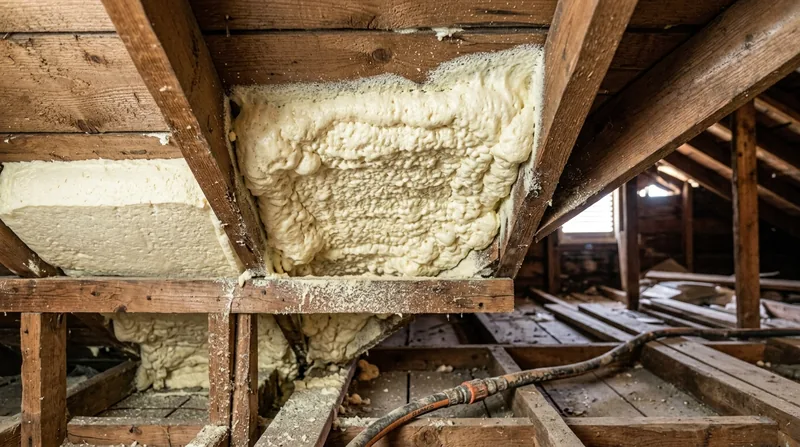




Champaign sits on the exposed farmland of Central Illinois, where cold, windy winters and hot, humid summers push heating and cooling costs higher every year. Older homes near downtown Champaign and Urbana, along with rental stock around the University, often carry uninsulated or poorly sealed walls that let winter drafts and summer moisture move straight through. Mid-century ranches scattered across Savoy, Mahomet, and Rantoul rely on vented attics that bake in summer and chill in winter, while newer subdivisions still face the same seasonal moisture and air leakage. Open cell spray foam insulation fills stud bays, seals rim joists, and closes gaps in attic spaces that fiberglass and blown-in insulation leave behind. It stops the humid air that creeps inward during summer and the dry winter drafts that reverse that flow, lowering both heating and cooling bills while improving comfort year-round. If your Champaign home has uninsulated walls, a drafty attic, or a damp basement, open cell foam offers a practical, affordable way to seal the envelope without tearing out finished walls. We help homeowners across Greater Champaign understand whether open cell is the right choice for their home and budget.
Why Open Cell Spray Foam Matters in Champaign's Climate
Champaign's hot, humid summers and cold, dry winters create a two-direction moisture and air leakage problem that fiberglass insulation alone cannot solve. Humid summer air pushes inward through uninsulated walls and attics, settling on cold surfaces and creating condensation. In winter, the pressure reverses, and dry indoor air leaks outward through the same gaps, carrying heat with it. Open cell spray foam seals both directions of that air leakage and slows moisture movement, keeping your attic, walls, and basement drier and more comfortable.
- Open cell foam fills stud cavities and rim joists completely, eliminating the gaps that fiberglass batts leave at edges and around obstacles.
- The material expands to conform to irregular framing and wiring, sealing air leaks that are invisible to the eye but measurable on an energy bill.
- Open cell is softer and lighter than closed cell, making it easier to install in older homes where framing is uneven or crowded with plumbing and electrical runs.
- The foam is less dense than closed cell, which means it breathes slightly and allows some moisture vapor to move through the material rather than trapping it at the surface.
In Champaign, where older rental stock and mid-century homes dominate the residential landscape, open cell foam is often the practical choice for retrofitting uninsulated walls and attics without the cost of closed cell or the labor of removing drywall.
Key info: Illinois building code requires a thermal barrier between spray foam and living space in most cases. Champaign's building department enforces the fifteen-minute thermal barrier standard, which typically means drywall, intumescent paint, or a code-listed material must cover the foam. Always verify what applies at your address before any foam is sprayed. See the City of Champaign Building Department for current code requirements.
How We Install Open Cell Spray Foam in Champaign Homes
Open cell spray foam installation begins with a site walkthrough to identify air leaks, assess framing conditions, and plan coverage. We measure the space, determine the R-value needed for your climate zone, and calculate the board footage. Before any foam is sprayed, we seal large gaps with caulk or backer rod, protect HVAC ducts and electrical boxes, and set up mechanical ventilation to manage odor and off-gassing during and after the spray.
- We inspect the substrate (framing, sheathing, or existing insulation) for moisture, mold, or damage and address any issues before spraying.
- The foam is sprayed in thin passes, building thickness gradually to ensure proper expansion and uniform density without over-application or sag.
- We maintain the manufacturer's drum temperature and mixing ratio throughout the job, using trained operators and calibrated equipment to guarantee consistent performance.
- Mechanical ventilation runs for the entire spray and typically continues for 24 to 48 hours after application, allowing the foam to cure and off-gases to leave the home.
- Once cured, the foam is trimmed flush with framing and covered with the thermal barrier required by code (drywall, intumescent paint, or equivalent material).
The entire process typically takes one to three days depending on the area being insulated. For a small attic or rim joist job, we often finish in a single day. Larger projects, such as uninsulated walls in a rental property or a full attic with multiple zones, may span two or three days.
Example: A three-bedroom rental house in Urbana with uninsulated rim joists and a settled attic typically receives open cell foam in the rim joist band (about 400 to 600 board feet) and a 4-inch attic top-up over existing blown-in (about 800 to 1,200 board feet). The job takes two days, including ventilation time and thermal barrier application. The homeowner can re-enter the home after 24 hours and can occupy fully after 48 hours.
Open Cell Spray Foam Installation Methods
| Approach | Description | Best for |
|---|---|---|
| Attic fill and air sealing | 2 to 4 inches of open cell sprayed directly onto the attic floor and along rim joists, sealing rim board, band joist, and penetrations. | Existing attics with settled or missing insulation, especially mid-century ranches in Champaign and Savoy. |
| Stud cavity fill (walls) | Open cell sprayed into wall cavities from inside without removing drywall, filling the entire cavity from sole plate to top plate. | Retrofit insulation in older homes near downtown Champaign and Urbana where walls are uninsulated and demolition is not desired. |
| Rim and band joist sealing | Foam sprayed into the rim joist cavity and band board to seal air leaks and block moisture entry from the foundation. | Basements and crawl spaces in Champaign and surrounding areas where rim joists are uninsulated or deteriorating. |
| Crawl space wall and band board sealing | Open cell foam applied to crawl space walls and band joists to reduce moisture infiltration and improve basement temperature stability. | Crawl spaces under older homes in Monticello, Tolono, and rural areas prone to seasonal moisture and cold-floor complaints. |
Each approach is tailored to the home's structure, the climate zone, and your budget. Closed cell spray foam is denser and more expensive but offers higher R-value per inch and better moisture resistance, making it ideal for metal buildings, sealed attics, and condensation control. Open cell is lighter, less expensive, and more forgiving in retrofit work where framing is irregular or access is tight.
Open Cell Spray Foam Insulation Cost in Champaign: What to Expect
Open cell spray foam in Champaign typically costs starting at $0.55 per board foot, with most jobs ranging from $0.55 to $0.70 per board foot depending on access, framing complexity, and the size of the project. A typical attic top-up of 800 to 1,200 board feet costs between $440 and $840 before thermal barrier and any removal of existing insulation. A rim joist and band board sealing project in a basement usually runs 400 to 600 board feet and costs $220 to $420. Larger retrofit jobs involving uninsulated walls in a rental property or a full-home air sealing can easily exceed 2,000 board feet and cost $1,100 to $1,400 or more.
Several factors move the cost up or down. Access and height affect how long the job takes and what equipment is needed. Framing that is crowded with plumbing, electrical, or HVAC requires more careful placement and sometimes more passes. Existing insulation that must be removed before foam is sprayed adds labor and disposal. The requirement for a thermal barrier (drywall, intumescent paint, or code-listed material) adds material and labor cost but is mandatory under Illinois code. The size of the project matters too: a small 200-board-foot rim joist job has a higher per-board-foot cost than a 1,500-board-foot attic because setup and travel are the same either way.
The best way to understand the cost for your home is to get a written estimate that specifies the R-value, thickness, and total board footage. We provide free written estimates that include those details and a breakdown of labor and materials. Call us at (447) 895-0419 or visit our pricing page to see typical ranges for common jobs in Champaign.
What to Look for When Hiring a Spray Foam Insulation Contractor Near Me in Champaign
Spray foam insulation is a technical trade, and the difference between a careful, code-compliant installation and a poor one is the difference between a home that stays comfortable and one that develops moisture, odor, or performance problems. When you are evaluating contractors for your Champaign home, ask for a written estimate that includes R-value, thickness, and board footage. Verify that the contractor is fully insured and can provide a certificate of insurance on request. Ask for references from recent jobs in your area, and call at least two of them to ask about the installation process, the odor and ventilation during cure, and whether the contractor was responsive after the job was done.
Understand what permits and thermal barrier requirements apply at your address. Champaign and surrounding cities have different building codes and permit processes, so a contractor who is familiar with your local building department is a strong signal. Ask whether the contractor will help you navigate permitting or whether you are responsible for pulling the permit yourself. Avoid any estimate that does not specify R-value and thickness, offers a price far below market without explanation, promises immediate re-entry before 24 hours, or cannot provide proof of insurance. These are the markers of a rig-and-run operation that prioritizes speed over quality and will be unreachable when the odor does not fade or the foam does not cure properly.
Contact us for a free, no-obligation estimate. We will visit your home, measure the space, explain what code requires at your address, and give you a written price with all the details you need to make a confident decision.
Open Cell Spray Foam Insulation in Champaign: Pricing Guide
| Service | Price | Details |
|---|---|---|
| Attic open cell spray foam (2 to 4 inches) | Starting at $0.55/board ft | Includes substrate inspection, foam application, and trim. Board footage depends on attic size and desired R-value thickness |
| Rim joist and band board sealing | Starting at $0.55/board ft | Seals air leaks around basement perimeter and foundation band. Typically 400 to 600 board feet for a standard Champaign basement |
| Wall cavity retrofit (uninsulated stud bays) | Starting at $0.60/board ft | Spray into cavities without drywall removal. Cost increases if framing is crowded with plumbing or electrical runs |
| Crawl space wall and band joist insulation | Starting at $0.55/board ft | Reduces moisture infiltration and stabilizes floor temperature. Substrate must be dry before foam is applied |
| Thermal barrier (drywall, paint, or code-listed material) | Additional cost | Required by Illinois code in most cases. Drywall typically adds $1 to $2 per square foot; intumescent paint adds $0.50 to $1 per square foot |
| Free estimate and written proposal | No charge | Includes site visit, R-value and thickness recommendation, board footage calculation, and detailed labor and material breakdown |
Indicative pricing, the exact cost depends on square footage, finish, and site access. Free personalized estimate within 24h at (447) 895-0419.


