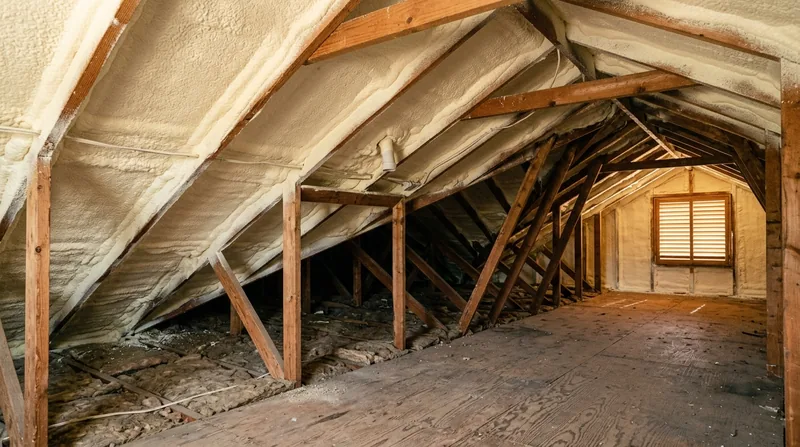




Champaign attics bake in summer heat and chill fast through cold Central Illinois winters. The open farmland setting here means wind sweeps unobstructed across rooflines, and older homes near downtown Champaign and Urbana, along with rental stock packed around campus, often carry attic insulation that has settled flat over decades, leaving rim joists and rafter cavities exposed to the full swing of seasonal temperature and moisture. Mid-century ranches and newer subdivisions toward Savoy and Mahomet rely on vented attics that work against the humidity and temperature extremes of this region. Attic spray foam insulation stops that energy loss and seals out the moisture that collects over failed fiberglass, cutting heating and cooling costs while protecting the wood structure underneath. We spray foam across the attic deck and rafters to create a thermal and moisture barrier that holds year-round, and we air seal the penetrations and rim joists that vented attics leave exposed.
Why Attic Spray Foam Insulation Matters in Champaign's Climate
Central Illinois winters are dry and cold, and summers are hot and humid. That moisture swing works both directions across the year: hot humid air pushes inward through walls and ceilings in summer, and in winter, dry indoor air reverses the drive outward. Vented attics amplify both problems. Cold air leaks down through unsealed rim joists and attic hatches in winter, and warm humid air rises into the attic in summer, where it condenses on cooler surfaces and settles into insulation that has already compacted. Fiberglass loses R-value when wet, and moisture that sits in the attic cavity promotes wood rot in rafters and joists and feeds mold growth in the decking. Spray foam stops the air leakage that lets that moisture in, and it creates a vapor-tight seal that prevents the moisture swing altogether.
- Sealed attic foam eliminates the stack effect that pulls cold air up through rim joists and down through living spaces in winter.
- Closed-cell spray foam resists moisture penetration and does not absorb water the way fiberglass does when humidity condenses in the cavity.
- Open-cell spray foam is vapor-permeable and works well in attics where the building envelope is already tight and interior humidity is controlled.
- Both methods stop the thermal gradient that forces air to move, cutting the load on your heating and cooling system year-round.
The result is a stable attic temperature, lower utility bills, and a roof structure that stays dry and sound.
Key info: Champaign building code requires thermal barriers on spray foam in attics. A fifteen-minute thermal barrier is the standard, and it must be verified by the building department at your address before foam is sprayed. We follow code at every job and coordinate with your local inspector to confirm what applies to your home.
For more detail on the difference between closed-cell and open-cell foam, see our page on closed-cell spray foam insulation.
How We Spray Foam Your Attic: The Process in Champaign
The work starts with a walk-through of your attic to measure the space, check for existing insulation and any moisture, and confirm the condition of the decking and rafters. We remove any damaged or failed insulation if needed, clean and dry the substrate, and set up mechanical ventilation to manage cure fumes. We then spray foam in controlled passes, building the specified thickness in layers to ensure proper chemical ratio and even coverage. The foam expands and hardens, and we trim the excess flush with the joists. Once the foam has cured, typically twenty-four to forty-eight hours, you can re-enter and use the attic normally. The whole process is straightforward, and we handle all the setup and cleanup.
- We measure your attic and determine the R-value and thickness needed based on your climate zone and energy goals.
- We remove old insulation if it is wet, compacted, or contaminated, and haul it away as part of the job.
- We set up mechanical ventilation during spray and cure to manage fumes and ensure safe re-entry within forty-eight hours.
- We spray foam in passes, allowing each layer to cure before adding the next, so the foam bonds properly and reaches full strength.
- We air seal rim joists, band joists, and penetrations around pipes and electrical runs to eliminate the air leakage paths that vented attics leave open.
The end result is an attic that is sealed, insulated, and ready to perform for decades.
Example: A ranch home in Savoy with a vented attic and settled fiberglass over the joists typically needs the old insulation removed, the attic deck cleaned and dried, and two to four inches of closed-cell foam sprayed across the entire rafter cavity. The job takes one to two days, and the homeowner saves on heating and cooling because the sealed attic no longer exchanges air with the outdoors. See our page on insulation removal for details on hauling away old material.
Attic Spray Foam Methods: Closed-Cell vs. Open-Cell
| Approach | Description | Best for |
|---|---|---|
| Closed-Cell Spray Foam | High-density foam with closed cell structure, R-value 6 to 7 per inch, resists moisture and air penetration, adds structural rigidity to rafters. | Attics with moisture risk, vented attics being converted to sealed, high-performance insulation goals, and homes in humid climates like Champaign where humidity swings are extreme. |
| Open-Cell Spray Foam | Lower-density foam with open cell structure, R-value 3.5 to 4 per inch, vapor-permeable, absorbs sound, lighter weight, lower cost per board foot. | Attics where the building envelope is already tight and interior humidity is controlled, sound-dampening applications, and budget-conscious retrofits of attics that are already relatively dry. |
| Top-Up with Blown-In Insulation | Adding blown cellulose or fiberglass over existing compacted insulation without removing it, no spray foam, lower cost, suitable for sound attics with good attic ventilation in place. | Attics where existing insulation is dry, not contaminated, and ventilation is working, and where the homeowner wants a simpler, lower-cost upgrade without foam and its cure requirements. |
| Full Removal and Spray Foam Replacement | Removing all old insulation, cleaning the attic deck, and spraying new foam from rafter to rafter, creating a sealed thermal and moisture barrier from scratch. | Attics with wet, compacted, or contaminated insulation, homes where the attic has never been sealed, and properties where moisture or mold history demands a complete fresh start. |
The choice between closed-cell and open-cell depends on your attic condition, your climate exposure, and your performance goals. We recommend closed-cell for Champaign attics because the humidity and temperature swings here make moisture control the priority. If your attic is already dry and well-ventilated, open-cell is a cost-effective option. If your attic insulation is sound and you just need more R-value, blown-in on top may be the right answer. We walk through all three at your free estimate.
Attic Spray Foam Insulation Cost in Champaign: What to Expect
Attic spray foam pricing in Champaign starts at roughly $1.50 per square foot for open-cell foam on a straightforward attic with good access and no removal required. Closed-cell foam, which is more durable and moisture-resistant, typically runs $2.50 to $4.00 per square foot depending on thickness and the complexity of the attic layout. The biggest cost drivers are the size of the attic, whether old insulation needs to be removed and hauled away, the condition of the substrate (wet or contaminated decking adds cost), and the thickness and R-value you want to achieve. A 1,200-square-foot attic with removal and closed-cell foam to R-30 typically costs between $3,500 and $5,500. A smaller attic or open-cell option may run $2,000 to $3,500. Every job is different, and the only way to get an accurate number is an on-site estimate where we measure, assess the existing insulation, and confirm what the building code requires at your address.
We always provide a written estimate that spells out the R-value, the thickness in inches, the square footage, and the total cost, so there are no surprises. We recommend getting two or three estimates from local contractors so you can compare not just price but the detail and confidence in each bid. A vague estimate with no R-value spec and no thickness is a red flag. See our pricing page for more detail on what moves the cost up or down.
Attic Spray Foam Insulation Near Me: What Champaign Homeowners Should Know When Hiring
Spray foam is a specialized trade, and the quality of the install depends entirely on the skill and discipline of the crew doing the work. A bad spray foam job can leave you with poor coverage, uneven thickness, cure problems, lingering odor, or even foam that does not bond to the substrate. The best protection is to hire a contractor who provides a detailed written estimate, carries full insurance, and has verifiable references from recent jobs in your area. Ask to see proof of insurance and the scope of coverage. Get the estimate in writing with R-value, thickness, and the total cost spelled out. Check references from homeowners in Champaign, Urbana, Savoy, or nearby towns who have had foam sprayed in their attics. Ask those references about the cure smell, how long it lasted, and whether the contractor was reachable after the job if questions came up. If your home is in an HOA, confirm that spray foam work does not trigger architectural review. If your city requires a permit, we help you understand what applies at your address and coordinate with the building department.
- Verify that the contractor carries full insurance and can provide a current certificate of insurance covering the spray foam work.
- Request a written estimate that names the foam type, R-value, thickness in inches, the square footage of the attic, and the total price with no hidden fees.
- Ask for references from three recent attic jobs in Champaign or nearby towns, and call those homeowners to ask about the quality of the work and the contractor's responsiveness.
- Confirm whether your city requires a permit for attic spray foam, and ask the contractor to explain what code applies at your address and who will coordinate with the building inspector.
- If you are in a master-planned community or HOA, check the architectural guidelines to see if exterior work or attic venting changes need approval before the job starts.
The contractor you choose should be straightforward about the process, honest about what the job costs, and reachable if you have questions after the foam cures. Call us at (447) 895-0419 for a free estimate, and we will walk through all of this with you. See our contact page to schedule.
Attic Spray Foam Insulation in Champaign: Pricing Guide
| Service | Price | Details |
|---|---|---|
| Open-Cell Spray Foam Attic | Starting at $1.50/sq ft | Lower-density foam, R-value 3.5 to 4 per inch, vapor-permeable, best for dry attics with controlled interior humidity |
| Closed-Cell Spray Foam Attic | Starting at $2.50/sq ft | High-density foam, R-value 6 to 7 per inch, moisture-resistant, ideal for Champaign humidity swings and sealed attic performance |
| Attic with Insulation Removal | From $3.50/sq ft | Includes haul-away of old fiberglass or foam, cleaning and drying the deck, then full spray foam installation and air sealing |
| Rim Joist and Band Joist Air Sealing | Starting at $500 | Spray foam around rim joists and band joists to eliminate stack effect and air leakage in basements and crawl spaces |
| Travel and Estimate | Included / Free | No separate mileage fee in Champaign and surrounding service areas, free written estimate with R-value and thickness spec within twenty-four hours |
Indicative pricing, the exact cost depends on square footage, finish, and site access. Free personalized estimate within 24h at (447) 895-0419.


