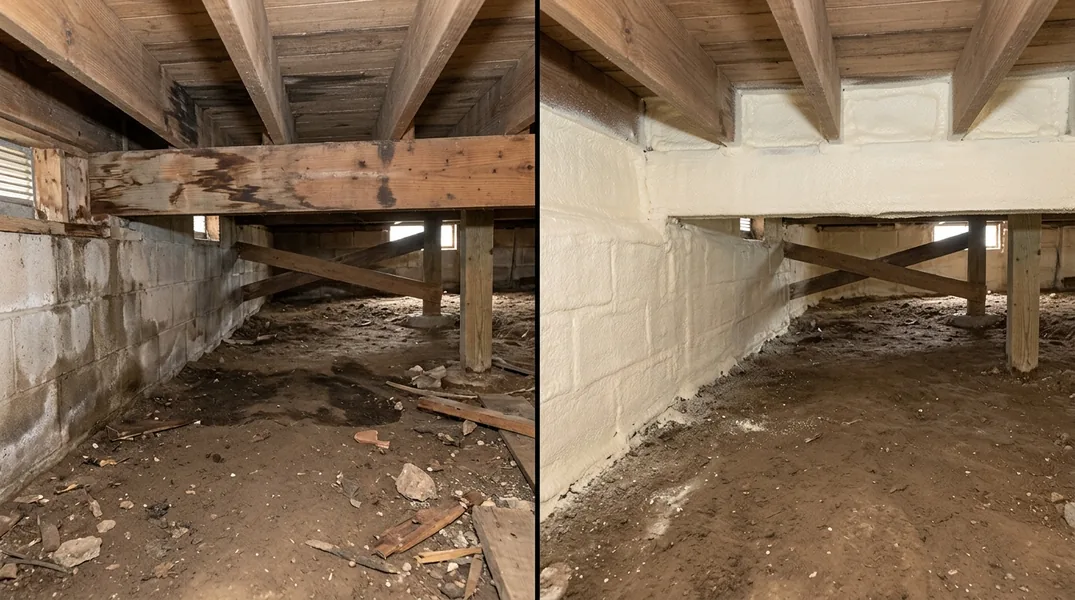
The Energy Crisis in Champaign Homes: Why Insulation Matters
If you live in Champaign, you know that winters can be brutal and summers sweltering. Traditional insulation methods often fail to keep up with these seasonal extremes, leaving homeowners with skyrocketing utility bills year-round. The average Champaign home loses significant energy through poorly insulated attics, walls, and crawl spaces. This energy loss forces your HVAC system to work overtime, driving up heating and cooling costs by 15 to 30 percent or more.
The real problem is that conventional fiberglass and cellulose insulation settle over time, develop gaps, and fail to seal air leaks effectively. Your attic might have R-value on paper, but if air is flowing freely through cracks and seams, you're essentially heating and cooling the outdoors. This is where modern insulation solutions come into play. Attic Spray Foam Insulation creates an airtight seal that traditional materials simply cannot match, dramatically reducing energy waste and cutting your monthly bills.
Understanding Spray Foam Insulation Cost Per Square Foot
When homeowners ask about spray foam insulation cost, the answer depends on several variables. The pricing for spray foam typically ranges from $1.50 to $3.50 per square foot for open-cell applications and $3.50 to $6.00 per square foot for closed-cell installations. These numbers reflect the material quality, application complexity, and the specific type of foam being used. An average 1,500 square foot attic might cost between $2,250 and $9,000 to fully insulate, depending on which foam type you choose and your current insulation condition.
The cost to insulate an attic isn't just about the foam itself. Professional installation, equipment, labor, and site preparation all factor into your final bill. Some homes require more prep work to remove old insulation or repair structural issues before spray foam can be applied. Others have complex attic layouts with multiple angles, obstructions, and tight spaces that increase labor time. Getting a detailed breakdown from a local contractor helps you understand where your money is going. Champaign Spray Foam Insulation offers transparent pricing and can walk you through each cost component during your consultation.
Attic Spray Foam Insulation Cost in Champaign: What to Budget
For homeowners in Champaign planning an attic project, budgeting correctly is essential. The cost to insulate an attic with spray foam depends primarily on square footage and foam type. Open Cell Spray Foam Insulation is the more affordable option, offering good thermal performance at a lower price point. It's ideal for interior applications where moisture control isn't a primary concern. Closed Cell Spray Foam Insulation, on the other hand, costs more but delivers superior R-value, moisture resistance, and structural reinforcement. Many homeowners find closed-cell foam worth the investment for attics because it provides maximum protection against the temperature swings common in our region.
A spray foam cost calculator can help you estimate expenses before calling a contractor. These tools typically ask for your attic dimensions, current insulation type, and desired R-value, then generate a rough cost range. However, an in-person assessment is always more accurate because contractors can identify hidden issues like air leaks, moisture damage, or structural problems that affect pricing. If you're ready to move forward, contact Champaign Spray Foam Insulation at (447) 895-0419 to schedule a free estimate tailored to your home's specific needs.
How Much Money Can You Actually Save on Energy Bills
The real payoff from spray foam insulation comes in energy savings. Homeowners who upgrade their attic insulation typically see reductions of 15 to 25 percent in their annual heating and cooling costs. For a typical Champaign household spending $1,800 to $2,400 annually on utilities, that translates to $270 to $600 in yearly savings. Over a 20-year period, these savings can easily exceed $5,400 to $12,000, far outweighing the initial investment. The exact amount depends on your current insulation condition, home size, local energy rates, and how efficiently your HVAC system operates.
Spray foam performs better than traditional insulation because it eliminates air leakage. Fiberglass batts and blown cellulose leave tiny gaps around framing, pipes, and electrical boxes. These gaps allow conditioned air to escape, forcing your heating and cooling system to compensate. Spray foam adheres directly to surfaces and expands to fill every void, creating a continuous thermal barrier. This airtight seal is especially valuable in Champaign where heating costs dominate winter budgets. Many homeowners report noticing comfort improvements within weeks of installation, with more consistent indoor temperatures and fewer cold spots.
Return on Investment: When Does Spray Foam Pay for Itself
Understanding your return on investment (ROI) helps justify the upfront expense of spray foam insulation. If your attic project costs $5,000 and saves you $400 per year, the payback period is roughly 12.5 years. After that, you're essentially getting free energy savings for the remaining life of the foam, which can last 80 years or more. Many homeowners view this as an excellent investment, especially when combined with other benefits like improved air quality, moisture control, and increased home resale value. Properties with modern spray foam insulation often appeal more to buyers because they promise lower utility bills and better comfort.
The ROI calculation becomes even more attractive when you factor in tax incentives and rebates. Some utility companies and government programs offer credits for energy efficiency upgrades. Additionally, improved insulation can lower your home's overall energy demand, potentially qualifying you for better insurance rates. The combination of monthly energy savings, potential rebates, and long-term durability makes spray foam one of the smartest home investments you can make. To explore your specific ROI potential, reach out to Champaign Spray Foam Insulation for a free estimate that includes projected savings based on your home's characteristics.
Closed Cell vs. Open Cell: Which Offers Better Value
Closed Cell Spray Foam Insulation and Open Cell Spray Foam Insulation each have distinct advantages when it comes to cost and performance. Closed-cell foam has a higher R-value per inch, typically R-6 to R-7, meaning you need less material to achieve your target insulation level. It also resists moisture, making it ideal for attics prone to condensation or minor water intrusion. The drawback is cost, which can be 50 to 100 percent higher than open-cell alternatives. However, for attics in challenging climates like ours, the superior performance often justifies the expense.
Open-cell foam costs less upfront, usually $1.50 to $2.50 per square foot compared to $3.50 to $6.00 for closed-cell. It has an R-value around R-3.5 per inch, so you'll need greater thickness to match closed-cell performance. Open-cell is breathable, meaning moisture can pass through it, which is beneficial in some applications but less ideal for attics. For most Champaign homeowners seeking maximum energy savings and long-term durability, closed-cell foam delivers better overall value despite higher initial costs. The superior insulation performance and moisture resistance mean fewer problems down the road and more consistent energy bill reductions.
Looking for a professional spray foam insulation contractor in Champaign? Champaign Spray Foam Insulation responds fast for all your spray foam insulation needs.
Get a Free Quote